wk6 10.28/10.30: Emergence, Self-Organization, Augmented Reality, Virtual Reality | Methodology Guidelines
Give a brief response to any of the material covered in this week's presentations
wk6 10.28/10.30: Emergence, Self-Organization, Augmented Reality, Virtual Reality | Methodology Guidelines
Re: wk6 10.28/10.30: Emergence, Self-Organization, Augmented Reality, Virtual Reality | Methodology Guidelines
I have worked with therapeutic VR before, where we had guided meditation with music in various nature environments embedded in our cognitive behavioural therapy app. In terms of interactivity, it was mostly just your default VR headset/mobile view, where you could view the environment in 360. However, nothing the user did really changed anything in the visuals.
When we looked at Osmose in class, I was intrigued by the concept of controlling the stimuli with your breath. I wonder if the constant state of floating and the lack of solid object spaces could help more with relaxation than the route that we followed. This particular method would have its limitations as well, since one needs to breathe all the time, and breathing triggers floating around no matter how slow. People might want to stay still and observe the environment, since ours did not have any spatial ambiguity or superimposed translucent worlds.
All the comparisons aside, I really liked how painterly Osmose felt while I was watching it. The full-body gear also works well with the concept of it being an art installation aimed at full immersion (this would not be feasible or accessible for a daily-use app). The buoyancy control via chest movements and the sense of constant, contemplative freefall are all great ideas for bringing different spaces into our current environment to induce a meditative state.
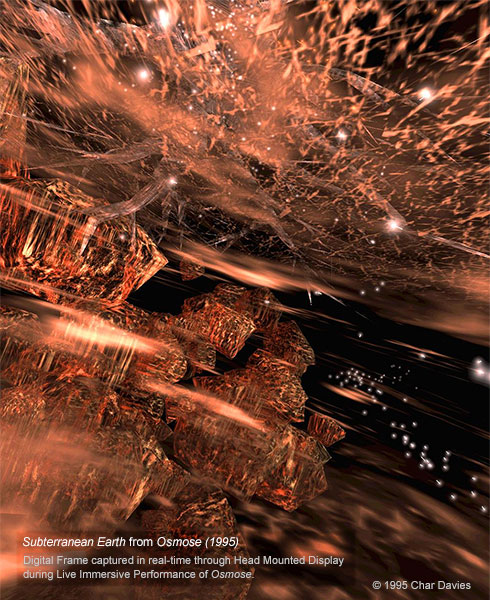
Also, one of the things that stood out to me most was that it wasn’t a solitary experience. Other museum-goers could see the shadow of the participant projected live on a wall as they experienced the piece – without headsets but with polarised glasses and spatial audio through headphones. This layer of shared presence adds a beautiful sense of connectedness to the artwork, which I appreciate.
When we looked at Osmose in class, I was intrigued by the concept of controlling the stimuli with your breath. I wonder if the constant state of floating and the lack of solid object spaces could help more with relaxation than the route that we followed. This particular method would have its limitations as well, since one needs to breathe all the time, and breathing triggers floating around no matter how slow. People might want to stay still and observe the environment, since ours did not have any spatial ambiguity or superimposed translucent worlds.
All the comparisons aside, I really liked how painterly Osmose felt while I was watching it. The full-body gear also works well with the concept of it being an art installation aimed at full immersion (this would not be feasible or accessible for a daily-use app). The buoyancy control via chest movements and the sense of constant, contemplative freefall are all great ideas for bringing different spaces into our current environment to induce a meditative state.
Also, one of the things that stood out to me most was that it wasn’t a solitary experience. Other museum-goers could see the shadow of the participant projected live on a wall as they experienced the piece – without headsets but with polarised glasses and spatial audio through headphones. This layer of shared presence adds a beautiful sense of connectedness to the artwork, which I appreciate.
-
ericmrennie
- Posts: 9
- Joined: Wed Oct 01, 2025 2:33 pm
Re: wk6 10.28/10.30: Emergence, Self-Organization, Augmented Reality, Virtual Reality | Methodology Guidelines
Generative art uses systems, such as algorithms, to make decisions based on a set of rules in order to produce artworks. Instead of directly creating images, the artist designs the system that generates them. What makes generative art compelling is that each artwork can be unique due to randomness, even when the same parameters are used.
Perhaps the earliest form of technological generative art emerges from the concept of cellular automata. In cellular automata, there is a grid of cells, each representing a binary state: 1 or 0, on or off. Every cell has a state and a neighborhood, and its state at any given moment is determined by a function that takes as its argument the state of its neighborhood at the previous timestep.
Rule #30 Cellular Automaton
A classic and renowned example of early generative art is John Conway’s Game of Life. The game consists of a grid of cells that follow a simple set of rules, forming complex patterns by “dying” or multiplying. Through emergence, these basic rules give rise to intricate behaviors that make the grid appear to come alive. The viewer never knows how long a particular sequence will last - some persist for a long time by multiplying in just the right configuration, while others die quickly.
John Conway's Game of Life
A more modern example of generative art is Casey Reas’ Process Compendium. In this work, Reas defines forms, elements, and behaviors that the forms follow. The elements function as algorithms, combining forms and behaviors in equations that produce his artworks. Across the series, Reas adds new forms, elements, and behaviors, causing the work to evolve from simple arrangements of interacting circles to complex environments. Beyond the digital realm, Reas also uses the processes he designs to create sculptures. He has even projected his processes behind an orchestra, altering the forms, elements, and behaviors in real time in response to the conductor and the music.
Casey Reas Process 4
Perhaps the earliest form of technological generative art emerges from the concept of cellular automata. In cellular automata, there is a grid of cells, each representing a binary state: 1 or 0, on or off. Every cell has a state and a neighborhood, and its state at any given moment is determined by a function that takes as its argument the state of its neighborhood at the previous timestep.
A classic and renowned example of early generative art is John Conway’s Game of Life. The game consists of a grid of cells that follow a simple set of rules, forming complex patterns by “dying” or multiplying. Through emergence, these basic rules give rise to intricate behaviors that make the grid appear to come alive. The viewer never knows how long a particular sequence will last - some persist for a long time by multiplying in just the right configuration, while others die quickly.
A more modern example of generative art is Casey Reas’ Process Compendium. In this work, Reas defines forms, elements, and behaviors that the forms follow. The elements function as algorithms, combining forms and behaviors in equations that produce his artworks. Across the series, Reas adds new forms, elements, and behaviors, causing the work to evolve from simple arrangements of interacting circles to complex environments. Beyond the digital realm, Reas also uses the processes he designs to create sculptures. He has even projected his processes behind an orchestra, altering the forms, elements, and behaviors in real time in response to the conductor and the music.
Last edited by ericmrennie on Sun Nov 16, 2025 4:50 pm, edited 4 times in total.
-
jintongyang
- Posts: 9
- Joined: Wed Oct 01, 2025 2:38 pm
Re: wk6 10.28/10.30: Emergence, Self-Organization, Augmented Reality, Virtual Reality | Methodology Guidelines
The concept of self-organization fascinates me deeply; it can be one of the most profound inspirations for art and design. The world itself is a vast system, and every creature within it is a smaller world as well. As human beings, we tend to control and intervene in our technological systems, while natural systems possess their own internal drives that shape their patterns of existence. These patterns are already a form of art—organized as if by divine logic. Many say the world is made of mathematics, and indeed, there are always ways to visualize this hidden order: the geometry of crystals, the texture of sand, the movement of fish schools, even the structures of human society. Each unit might be small and unconscious, yet self-organizing systems gather them into larger formations that mirror the laws of the universe. Trees, for instance, display fractal structures, which can even be simulated on machines through mathematical formulas and applied on human technologies. I can’t help but wonder: how do individual entities spontaneously gather into certain patterns, and what does that mean for our sense of self-identity?
In nature, self-organization produces organic patterns without conscious intent. Nicolas Baier’s Mappemonde (2022) (Fig.1) beautifully embodies this idea: a marble sculpture that merges tree-like networks, rhizomatic connections, and reticular structures. The work captures how human-made machines can carve the traces of self-organizing systems into stone—a material that preserves time itself. It evokes a profound metaphor for life, time, and the intersection between human order and natural emergence.
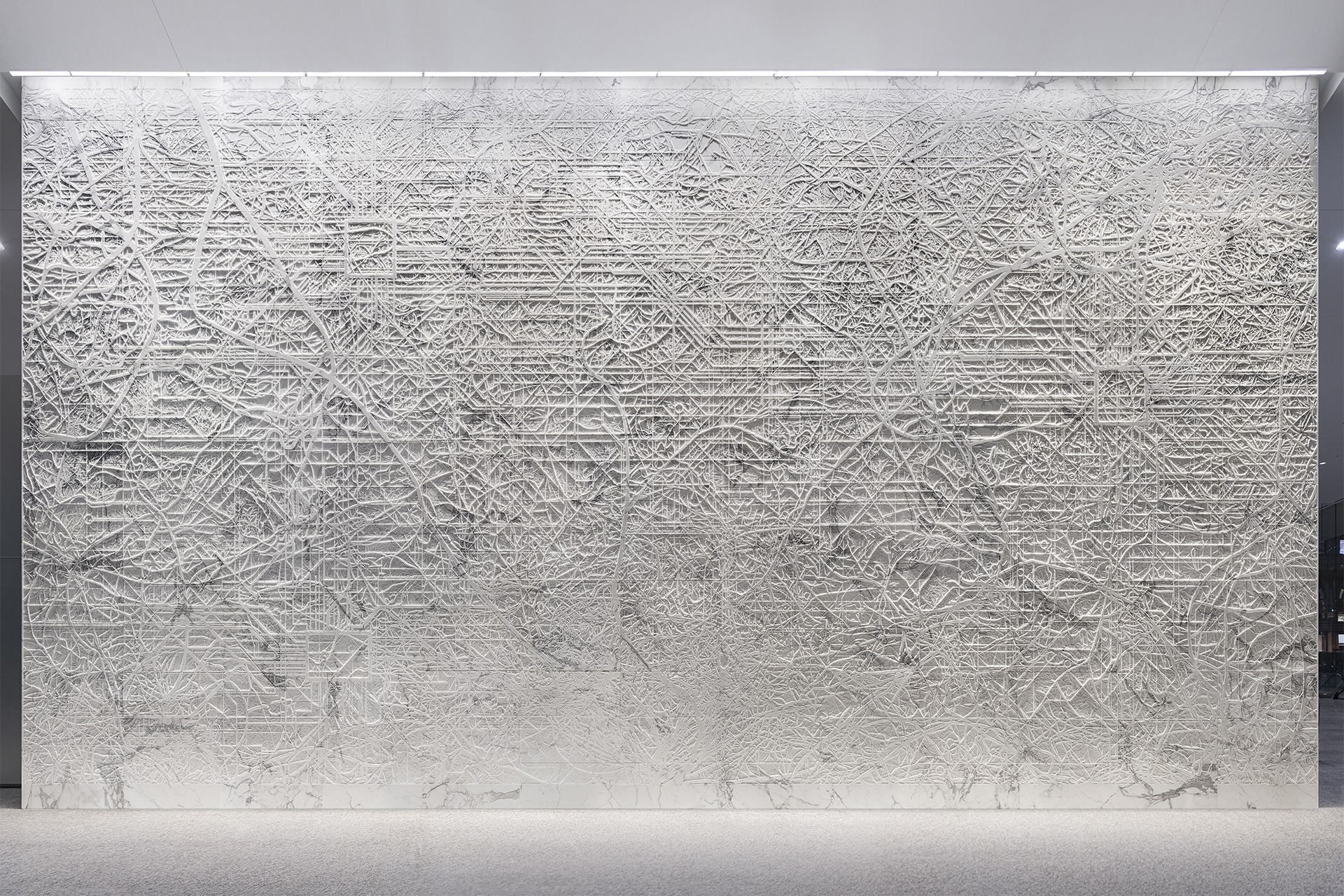
Fig.1. Nicolas Baier, Mappemonde, 2022
In human society, however, agency is often placed above all else. As individuals awaken to their unique value, we must ask: can we still be “self-organized” within complex systems of labor, technology, and information? Can we embrace our latent, self-motivated patterns (our hidden drives) to live in a more autonomous yet connected way?
Weidi Zhang’s A Walled City (2025) (Fig.2) reflects on these questions through a self-organizing virtual city where individuals perform their roles within an evolving collective structure. It prompts us to think about perspective: what changes when we stand outside a system versus when we are immersed within it? Virtual reality could provide a powerful space to explore this contrast. For instance, Ian Cheng’s VR trilogy Emissaries (2017) (Fig.3)presents an evolving ecosystem driven by AI simulation, allowing viewers to experience emergence and adaptation firsthand, which can be an excellent example of self-organization in an immersive medium.

Fig.2. Weidi Zhang, A Walled City, 2025
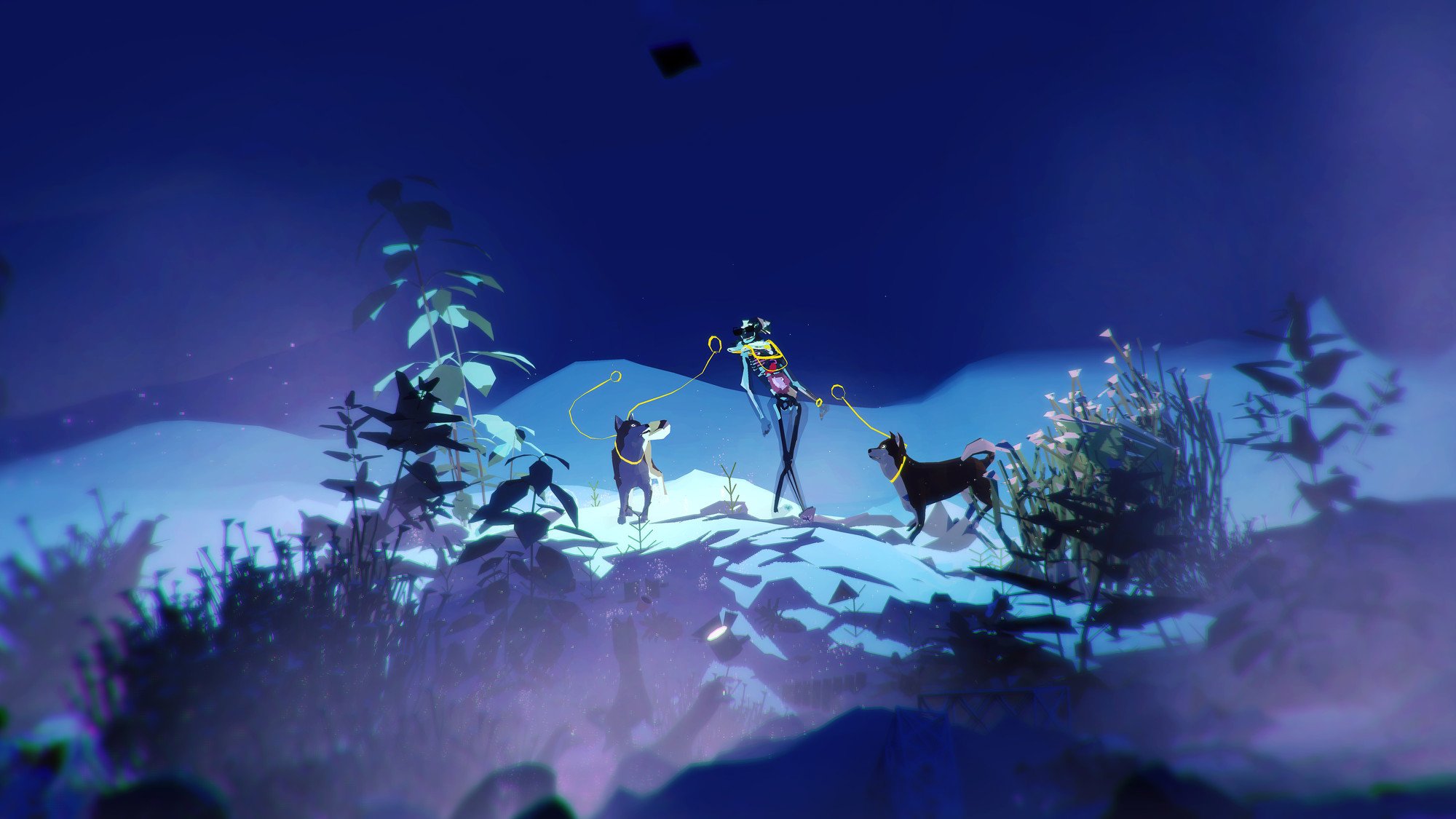
Fig.3. Ian Cheng, Emissaries, 2017
Ultimately, the study of self-organization reminds me that creation is never isolated. Each pattern we form, each system we build, participates in a larger rhythm of emergence. In art, as in life, perhaps the goal is not to control the system, but to learn how to move with it, to let the patterns unfold and find ourselves within their flow.
In nature, self-organization produces organic patterns without conscious intent. Nicolas Baier’s Mappemonde (2022) (Fig.1) beautifully embodies this idea: a marble sculpture that merges tree-like networks, rhizomatic connections, and reticular structures. The work captures how human-made machines can carve the traces of self-organizing systems into stone—a material that preserves time itself. It evokes a profound metaphor for life, time, and the intersection between human order and natural emergence.
Fig.1. Nicolas Baier, Mappemonde, 2022
In human society, however, agency is often placed above all else. As individuals awaken to their unique value, we must ask: can we still be “self-organized” within complex systems of labor, technology, and information? Can we embrace our latent, self-motivated patterns (our hidden drives) to live in a more autonomous yet connected way?
Weidi Zhang’s A Walled City (2025) (Fig.2) reflects on these questions through a self-organizing virtual city where individuals perform their roles within an evolving collective structure. It prompts us to think about perspective: what changes when we stand outside a system versus when we are immersed within it? Virtual reality could provide a powerful space to explore this contrast. For instance, Ian Cheng’s VR trilogy Emissaries (2017) (Fig.3)presents an evolving ecosystem driven by AI simulation, allowing viewers to experience emergence and adaptation firsthand, which can be an excellent example of self-organization in an immersive medium.
Fig.2. Weidi Zhang, A Walled City, 2025
Fig.3. Ian Cheng, Emissaries, 2017
Ultimately, the study of self-organization reminds me that creation is never isolated. Each pattern we form, each system we build, participates in a larger rhythm of emergence. In art, as in life, perhaps the goal is not to control the system, but to learn how to move with it, to let the patterns unfold and find ourselves within their flow.
-
jcrescenzo
- Posts: 7
- Joined: Wed Oct 01, 2025 2:17 pm
Re: wk6 10.28/10.30: Emergence, Self-Organization, Augmented Reality, Virtual Reality | Methodology Guidelines
Casey Reas piece is a very brilliant but simple idea which is “seven years of following a line.” Through these years, Reas takes something very rudimentary and then programs increasing complex behaviors into objects. With each programmed behavior, he generates a series of artistic works, revealing how the combination of behaviors creates compositions of complexities.
What I enjoy about the work there is this artistic intersection between the creation of aesthetically beautiful compositions and the behavior of the machine in a creative creation of the artwork. One of things I dislike about certain AI artwork is that often the process of actual creation is obscured from the artist and the audience. The black box effect. My view is that artistic control is reduced for the sake of technical production.
So take Deepfakes, which is an impressive computation process. They achieve a sort of technical precision of replicating someone's face. For Disney they are able to take James Dean or any other dead actor (whose image they hold the rights to) recreate their image in a film. This is a technical achievement. This process is driven by our technical abilities and legal ownership rather than artistic choices.
https://www.bbc.com/future/article/2023 ... m-the-dead
Most importantly it ignores the craft of acting. Acting is a process in which humans make subtle decisions around the cadence, the timing, the choice and the fluency of words. They control the movement of eyes, their facial expressions and other body movements. These are unconscious and conscious behavioral choices that are appropriate to situations but the result of external stimulus.
In the case of linguistic exchange, humans say things which are innovative and new but also appropriate to situations all the time. They aren’t compelled behaviors.
https://www.youtube.com/watch?v=E3U6MsdBalg
https://en.wikipedia.org/wiki/Syntactic_Structures
Computers are programmed or compelled to do something. Animals similarly respond to situations or stimuli instinctively. But Humans do something very unique.
So take Deepfakes, which is an impressive computation process. They achieve a sort of technical precision of replicating someone's face. For Disney they are able to take James Dean or any other dead actor (whose image they hold the rights to) recreate their image in a film. This is a technical achievement. This process is driven by our technical abilities and legal ownership rather than artistic choices.
Most importantly it ignores the craft of acting. Acting is a process in which humans make subtle decisions around the cadence, the timing, the choice and the fluency of words. They control the movement of eyes, their facial expressions and other body movements. These are unconscious and conscious behavioral choices that are appropriate to situations but the result of external stimulus.
In the case of linguistic exchange, humans say things which are innovative and new but also appropriate to situations all the time. They aren’t compelled behaviors.
https://www.youtube.com/watch?v=E3U6MsdBalg
https://en.wikipedia.org/wiki/Syntactic_Structures
Computers are programmed or compelled to do something. Animals similarly respond to situations or stimuli instinctively. But Humans do something very unique.
-
shashank86
- Posts: 9
- Joined: Wed Oct 01, 2025 2:36 pm
Re: wk6 10.28/10.30: Emergence, Self-Organization, Augmented Reality, Virtual Reality | Methodology Guidelines
First of all, thank you for covering this topic. I used to think a lot about the systems and their evolution, starting from my body to everything else. This makes me understand the process of formation of anything, a pattern, an emotion, a decision, a colour, instincts, and an action made by every being to the elements that exist.
I would like to talk about Stephen Wolfram's Chapter 8: Implications for Everyday Systems
Stephen Wolfram’s A New Kind of Science, and particularly Chapter 8, suggests that the complexity of everyday systems, from physical patterns to biological forms and even human emotions and decisions, can emerge from extremely simple computational rules repeated over time. This view aligns with my understanding that any phenomenon, a pattern, an emotion, an instinct, or a choice may arise from underlying micro-processes interacting in structured ways. Just as mathematics grew from basic counting systems into highly sophisticated frameworks, and just as biological evolution shaped the human body from simple survival mechanisms into complex organs and behaviors, Wolfram’s theory proposes that natural and human systems similarly evolve through iterative, rule-based formation. This perspective parallels my belief in the meaning and necessity of abstractness, showing that abstract structures and experiences are not accidental but are computationally natural outcomes of simple processes organizing themselves into higher forms.
https://www.wolframscience.com/nks/chap ... y-systems/
Similar works:
Modeling Big Data (2014) by Katherine Behar - https://katherinebehar.com/art/modelin ... index.html
I would like to talk about Stephen Wolfram's Chapter 8: Implications for Everyday Systems
Modeling Big Data (2014) by Katherine Behar - https://katherinebehar.com/art/modelin ... index.html
-
firving-beck
- Posts: 8
- Joined: Wed Oct 01, 2025 2:26 pm
Re: wk6 10.28/10.30: Emergence, Self-Organization, Augmented Reality, Virtual Reality | Methodology Guidelines
In considering these works, something I found particularly interesting was the distinction between self-driven, exploratory pieces, and those which are more structured, critically investigating social dynamics. I found Osmose to be example of the former, given its emphasis on exploration and the individual, showing the potential for AR as a tool for discovery. In contrast, Warriors points to lack of agency within social structures, examining the potential for tech to exploit.
Char Davies’ Osmose (1995) is an immersive VR environment, which allows users to navigate a series of world-spaces as they breathe. The piece presents this technology as a tool for self exploration and profound emotional processing. The role of agency is instrumental in this work. Interestingly, the experience is abstracted rather than rendered with extreme clarity. The style reminds me of impressionistic paintings, with features even resembling brushstrokes at times. I find that this style of painting feels more "real" and immersive, more closely resembling the surrounding world than hyperrealism does. Similarly, the style of Osmose makes the interaction feel softer and more emotionally resonant, especially when linked to the embodied action of breathing.
James Coupe’s Warriors (2020) takes gallery visitor’s faces, and then uses an algorithm to sort them based on analysis (using perceived demographic, economic, and occupational markers). The installation then imposes these faces as deepfakes on movie scenes. This piece examines the danger of surveillance and potential for AI to reinforce prior-existing bias and inequality. Note the lack of agency that viewers have in the algorithmic process. The use of deepfakes reads as very uncanny, making the viewer uncomfortable. Accordingly, the discomfort very effectively conveys the message of the piece. It speaks to the manipulation of data, and how personal information can be extracted without consent and then weaponized. Warriors focuses on larger social structures and prior existing power dynamics, emphasizing the danger of algorithmic categorization.
Char Davies’ Osmose (1995) is an immersive VR environment, which allows users to navigate a series of world-spaces as they breathe. The piece presents this technology as a tool for self exploration and profound emotional processing. The role of agency is instrumental in this work. Interestingly, the experience is abstracted rather than rendered with extreme clarity. The style reminds me of impressionistic paintings, with features even resembling brushstrokes at times. I find that this style of painting feels more "real" and immersive, more closely resembling the surrounding world than hyperrealism does. Similarly, the style of Osmose makes the interaction feel softer and more emotionally resonant, especially when linked to the embodied action of breathing.
- Char Davies, Osmose (1995)
- James Coupe, Warriors (2020)
Re: wk6 10.28/10.30: Emergence, Self-Organization, Augmented Reality, Virtual Reality | Methodology Guidelines
You Only Have Seven Seconds is a fusion of filmmaking and installation art to represent the development of memory visually. The artist leverages an AI network to convert whispered memories from thousands of visitors to “synthetic visual” images, thereby generating an ever-expanding “memory” database created by the machine itself. The final artistic product is generated not by one input but by cumulating micro-actions. Voice recognition software, text completion software, and text-to-image software act as subunits of a self-organizing system, splicing fragments to create dynamic stories. The portrait of identity constructed for human experience is developed not just by narratives but also by machine perception, thereby making AI itself an agent aiding memory conservation or recreation—the same dynamic and fragmented reality for human memory itself.
Osmose by artists Char Davies introduces a totally new immersive experience of virtual reality that does away with traditional control logic concepts and techniques of reaching objectives and manipulating objects. It makes use of a respiratory and balancing navigation system to create a two-way interaction between the immersive user and the virtual world.
This modality of interaction is essentially an embodied one: it is self-organizing: it is coupled to the actual rhythms of one's own flesh, while one's respiratory rhythms adapt to the dynamic shifts of landscape. This is achieved through smooth translations between cartographical coordinates and forests, ponds, and abysses.
Consequently, “Infiltration” surpasses being simply a virtual reality experience and instead is a procedure for delving into the nexus of self and world through the use of VR as a perceptual amplifier to demonstrate how consciousness reshapes itself when no longer bound by physical laws or limitations.
This is a massive digital ecosystem project that turns all of Times Square into The Ocean through synchronized LED screens. Oceanographica images such as coral reefs, schools of fish swimming around each other, and rolling waves cover several buildings to create one visual field. While one cannot control or manipulate the images themselves, simply being able to walk through them makes one a part of this self-organizing system. This work rearranges the viewer's collective attention and behavioral patterns to coalesce into a kind of transient community of onlookers united by their fascination with the visual spectacle presented to them.
This installation provides insight into just how large-scale the influence of these installations is on the communal experience: they project imaginary information onto actual buildings to create areas of hybrid reality where these spaces converge. The entire network itself is also like a living being, full of expansion and rhythms.
- Film Still, You Only Have Seven Seconds, 2025
- Film Still, You Only Have Seven Seconds, 2025
Osmose by artists Char Davies introduces a totally new immersive experience of virtual reality that does away with traditional control logic concepts and techniques of reaching objectives and manipulating objects. It makes use of a respiratory and balancing navigation system to create a two-way interaction between the immersive user and the virtual world.
This modality of interaction is essentially an embodied one: it is self-organizing: it is coupled to the actual rhythms of one's own flesh, while one's respiratory rhythms adapt to the dynamic shifts of landscape. This is achieved through smooth translations between cartographical coordinates and forests, ponds, and abysses.
Consequently, “Infiltration” surpasses being simply a virtual reality experience and instead is a procedure for delving into the nexus of self and world through the use of VR as a perceptual amplifier to demonstrate how consciousness reshapes itself when no longer bound by physical laws or limitations.
- Tree Pond from Osmose(1995)
- Tree from Osmose(1995)
- Subterranean Earth from Osmose(1995)
This is a massive digital ecosystem project that turns all of Times Square into The Ocean through synchronized LED screens. Oceanographica images such as coral reefs, schools of fish swimming around each other, and rolling waves cover several buildings to create one visual field. While one cannot control or manipulate the images themselves, simply being able to walk through them makes one a part of this self-organizing system. This work rearranges the viewer's collective attention and behavioral patterns to coalesce into a kind of transient community of onlookers united by their fascination with the visual spectacle presented to them.
This installation provides insight into just how large-scale the influence of these installations is on the communal experience: they project imaginary information onto actual buildings to create areas of hybrid reality where these spaces converge. The entire network itself is also like a living being, full of expansion and rhythms.
- Public Art Times Square(2024)
Re: wk6 10.28/10.30: Emergence, Self-Organization, Augmented Reality, Virtual Reality | Methodology Guidelines
(1)Self-Organization
https://www.mat.ucsb.edu/~g.legrady/aca ... elforg.pdf
After reading this chapter about self-organization, one thing that really attracted me is how complex patterns can come from really simple interactions, especially when each component only follows local information. I always assumed that a large-scale order needed some kind of leader, like the book mentioned that marching bands or carpenters used instructions. But the examples of fish schooling or ants forming trails without any central control honestly surprised me. It made me rethink how much “organization” can happen simply through individuals reacting to their neighbors.
The fish example also stood out to me. I never realized that each fish doesn’t know the whole shape of the school; it’s literally just responding to the position and movement of the nearest few fish. But somehow the whole group ends up looking so coordinated. It made me think about how the global pattern is basically something that nobody inside the system actually “knows,” yet it still appears.
(2)Osmose(1995)
There are two things that really attracted my attention in this work. The first one is the idea of using breathing as the main way to move through the virtual world. I honestly never thought of VR working like that. Usually VR feels very “hands-first,” but here the whole system responds to something as simple and natural as inhaling and exhaling. It made me realize how little attention I normally pay to my own breath, and how strange and interesting it would be to have my body—not a controller—guiding the experience.
Another moment that stuck with me is how the piece starts inside a Cartesian grid, and then as you breathe, it slowly turns into a forest. I thought that transition was really poetic. It’s like the work is deliberately taking you from something super technical into something alive and emotional. Instead of jumping between VR “levels,” the shift feels more like drifting from one state of mind to another.
https://www.mat.ucsb.edu/~g.legrady/aca ... elforg.pdf
After reading this chapter about self-organization, one thing that really attracted me is how complex patterns can come from really simple interactions, especially when each component only follows local information. I always assumed that a large-scale order needed some kind of leader, like the book mentioned that marching bands or carpenters used instructions. But the examples of fish schooling or ants forming trails without any central control honestly surprised me. It made me rethink how much “organization” can happen simply through individuals reacting to their neighbors.
The fish example also stood out to me. I never realized that each fish doesn’t know the whole shape of the school; it’s literally just responding to the position and movement of the nearest few fish. But somehow the whole group ends up looking so coordinated. It made me think about how the global pattern is basically something that nobody inside the system actually “knows,” yet it still appears.
(2)Osmose(1995)
There are two things that really attracted my attention in this work. The first one is the idea of using breathing as the main way to move through the virtual world. I honestly never thought of VR working like that. Usually VR feels very “hands-first,” but here the whole system responds to something as simple and natural as inhaling and exhaling. It made me realize how little attention I normally pay to my own breath, and how strange and interesting it would be to have my body—not a controller—guiding the experience.
Another moment that stuck with me is how the piece starts inside a Cartesian grid, and then as you breathe, it slowly turns into a forest. I thought that transition was really poetic. It’s like the work is deliberately taking you from something super technical into something alive and emotional. Instead of jumping between VR “levels,” the shift feels more like drifting from one state of mind to another.
- Attachments
-
Re: wk6 10.28/10.30: Emergence, Self-Organization, Augmented Reality, Virtual Reality | Methodology Guidelines
Although VR is often perceived as a cutting-edge technology, its history is much older than many people assume. The head-mounted display based form of VR that we are familiar with today was already developed in the late 1960s by Ivan Sutherland and his students at Harvard, and VR has continued to evolve since then. The release of the HTC Vive in 2015 once again drew widespread attention, and VR continues to develop today through ongoing experimentation and technical innovation.
Because I am currently creating a project that integrates VR with a breathing sensor, Char Davies’s Osmose (1995) holds particular significance for me. Osmose connects the most fundamental human activity, breathing, with movement inside a virtual environment. The participant rises when inhaling and sinks when exhaling, which creates an intuitive and deeply embodied experience. This approach makes Osmose one of the earliest artworks that used biometric signals as a central parameter for shaping a virtual world, presenting a new possibility for meaningful interaction through the body.
According to Davies (1995), who gathered responses from approximately 25,000 participants, the after-effects of immersion in Osmose can be profound. As she writes, “Immersants often feel as if they have rediscovered an aspect of themselves, of being alive in the world, which they had forgotten, an experience which many find surprising, and some very emotional” (Davies, 1995). Many participants reported that they felt they had rediscovered a forgotten part of themselves, especially the sense of being alive in the world. Some described this realization as surprising, while others experienced it as deeply emotional.
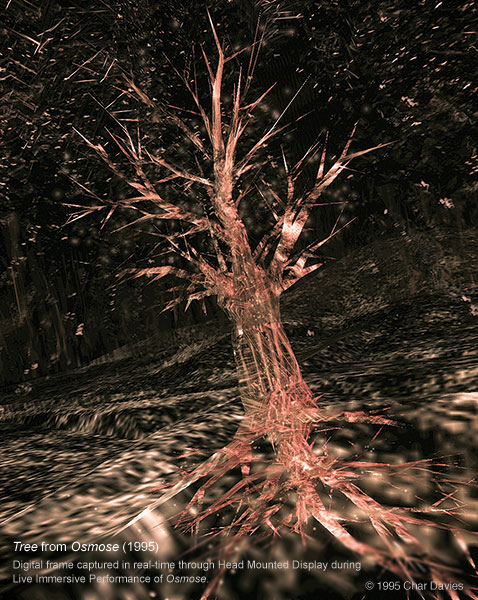
Davies (1995) explains that these reactions support her belief that traditional boundaries between humans and machines can be transcended while reaffirming the role of the body. She also states that immersive virtual space, when freed from conventional expectations, provides a context for exploring one’s subjective experience of being in the world, in a space where boundaries between inner and outer, and between mind and body, begin to dissolve. This perspective highlights how VR can serve as an environment for deeper awareness of embodied presence.
I am deeply inspired by the way Davies used VR and biometric signals as a tool to explore perceptual interactions between the self and the surrounding world. The fact that such experimental work was already taking place in the 1990s encourages me to reconsider the history of VR not simply as a field of technological progress but as a medium with a long tradition of artistic and perceptual investigation.
Davies, C. (1995). Osmose. Immersence Inc. Retrieved November 23, 2025, from https://www.immersence.com/osmose/
Because I am currently creating a project that integrates VR with a breathing sensor, Char Davies’s Osmose (1995) holds particular significance for me. Osmose connects the most fundamental human activity, breathing, with movement inside a virtual environment. The participant rises when inhaling and sinks when exhaling, which creates an intuitive and deeply embodied experience. This approach makes Osmose one of the earliest artworks that used biometric signals as a central parameter for shaping a virtual world, presenting a new possibility for meaningful interaction through the body.
According to Davies (1995), who gathered responses from approximately 25,000 participants, the after-effects of immersion in Osmose can be profound. As she writes, “Immersants often feel as if they have rediscovered an aspect of themselves, of being alive in the world, which they had forgotten, an experience which many find surprising, and some very emotional” (Davies, 1995). Many participants reported that they felt they had rediscovered a forgotten part of themselves, especially the sense of being alive in the world. Some described this realization as surprising, while others experienced it as deeply emotional.
Davies (1995) explains that these reactions support her belief that traditional boundaries between humans and machines can be transcended while reaffirming the role of the body. She also states that immersive virtual space, when freed from conventional expectations, provides a context for exploring one’s subjective experience of being in the world, in a space where boundaries between inner and outer, and between mind and body, begin to dissolve. This perspective highlights how VR can serve as an environment for deeper awareness of embodied presence.
I am deeply inspired by the way Davies used VR and biometric signals as a tool to explore perceptual interactions between the self and the surrounding world. The fact that such experimental work was already taking place in the 1990s encourages me to reconsider the history of VR not simply as a field of technological progress but as a medium with a long tradition of artistic and perceptual investigation.
Davies, C. (1995). Osmose. Immersence Inc. Retrieved November 23, 2025, from https://www.immersence.com/osmose/