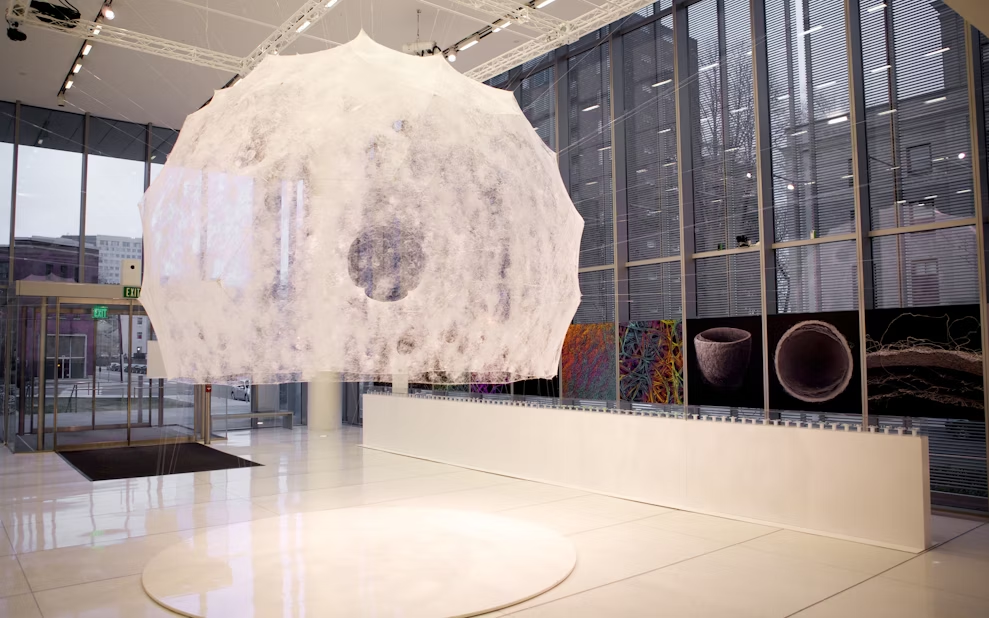
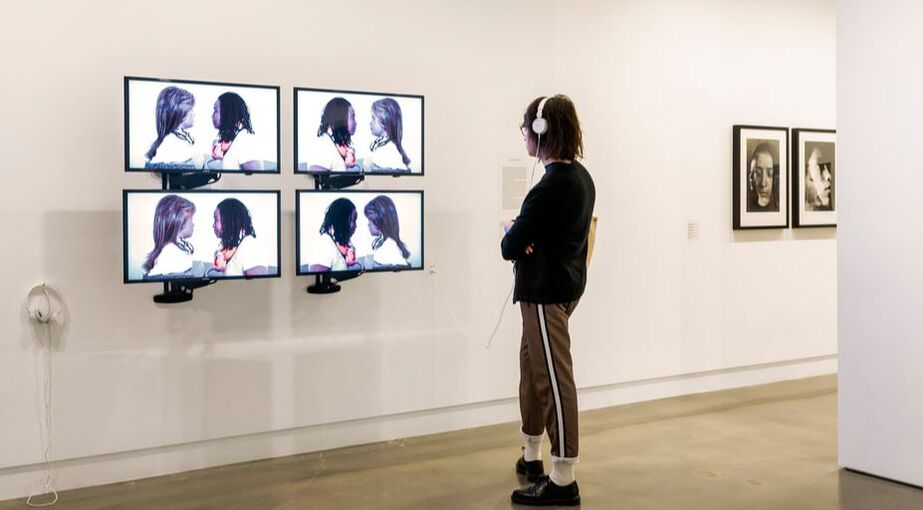
Looking at four of this week's examples, these four works, Antonio Somaini's academic essay "Algorithmic Images" (2023), Max Dean's Robotic Chair (2006), and Varvara & Mar's installations A Needle in a Haystack (2024) and Dream Painter (2021), range from theoretical scholarship to practical art. They provide different insights into how robotics, automation, and machine vision relate to human experiences. Somaini's essay establishes a conceptual framework. It outlines how deep learning algorithms have transformed image capture, generation, and perception since the early 2010s. He argues that machine vision creates a new kind of automated visual perception. This shifts the focus from the human viewpoint and reorganizes what we can see. His analysis includes convolutional neural networks for classification, generative adversarial networks for making images, and diffusion models for turning text into images. He examines how these technologies alter our connection to visual culture. A key point in his work is "latent space," the abstract space where deep-learning systems encode and manipulate representations. He argues that to understand today's culture influenced by these algorithms, we must confront this complex mathematical landscape. His work also highlights the political aspects of training datasets, citing studies that show political factors shape the structure of training sets.
In contrast to Somaini's theoretical ideas, Max Dean's Robotic Chair presents an early approach to robotics and machine vision. This sculpture, created in partnership with engineer Raffaello D'Andrea and industrial designer Matt Donovan, can fall apart and then reassemble itself. It has a robot integrated into the seat and a computerized vision system. The work carries a clear metaphor: the chair symbolizes the cycle of falling and getting back up, falling apart and putting ourselves together repeatedly. This suggests that robotics is not about intelligence, but about reflecting on existence. Here, machine vision serves only a practical role (localization and reassembly) rather than the analytical or creative roles typical of today's AI systems. Created after two decades of Dean's work in kinetic sculpture, this piece predates the current AI trend, reminding us that robotic art has origins in mechanical traditions that existed long before neural networks and latent spaces.
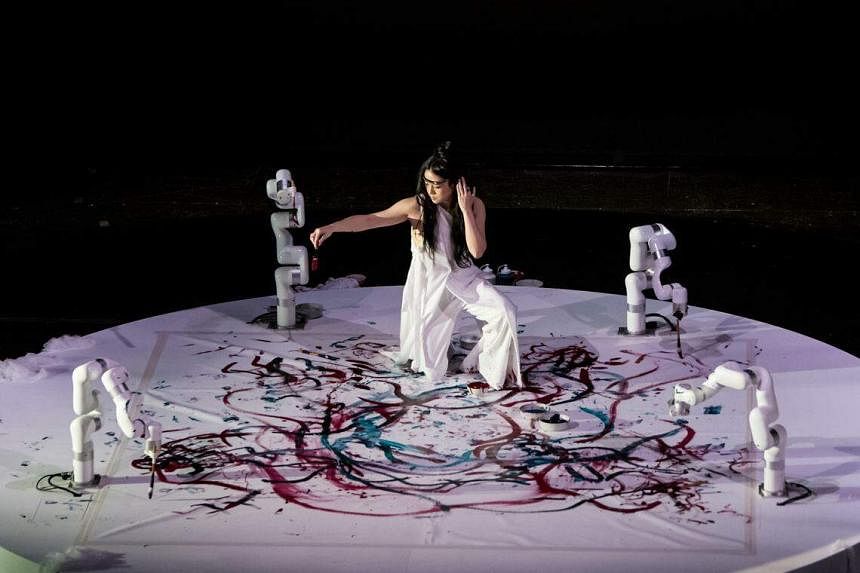
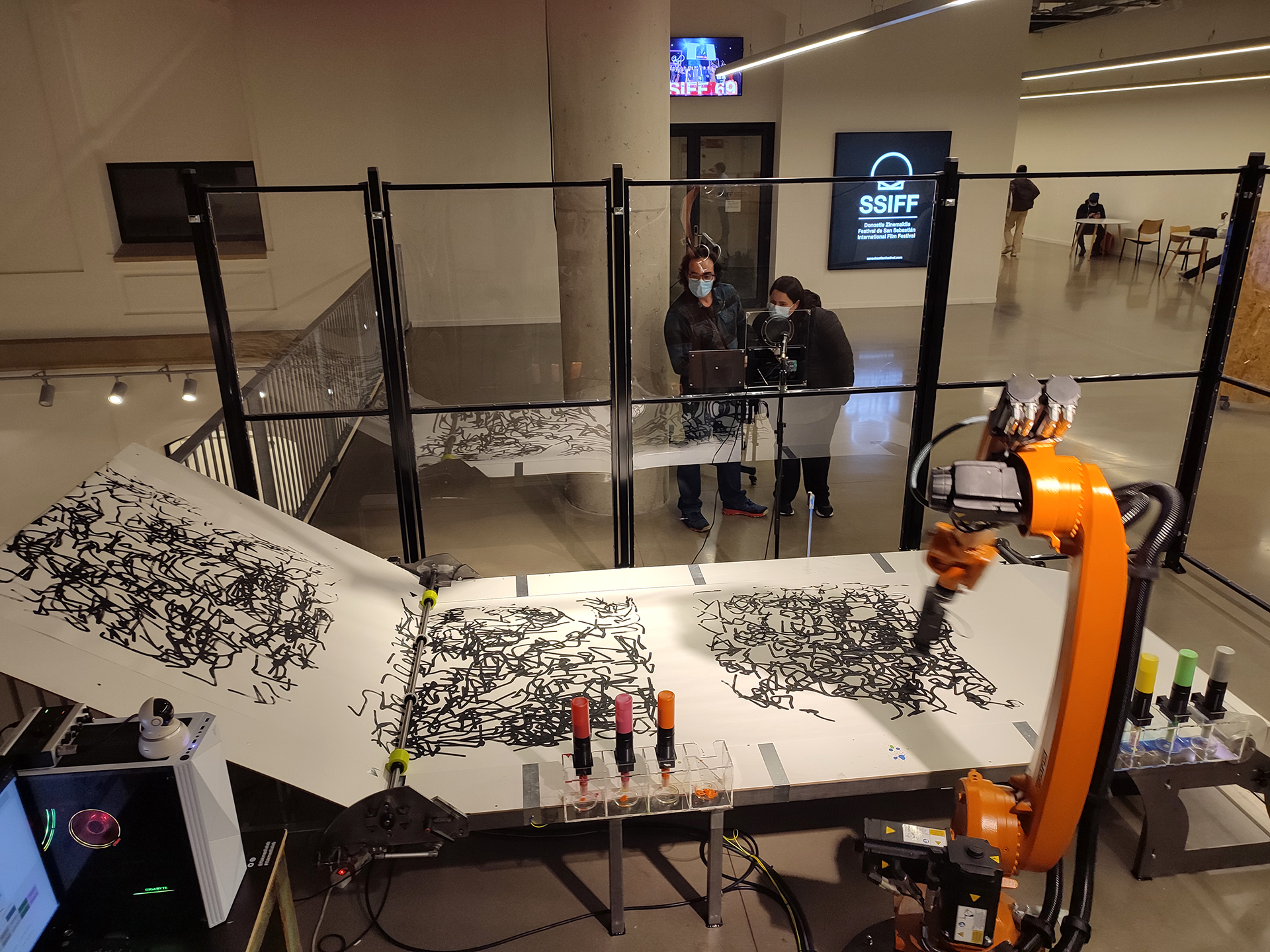
Varvara & Mar's two installations show how the same artistic approach can critique and explore AI systems. A Needle in a Haystack takes a critical and somewhat sarcastic view of tech hype. A robot in the center of a haystack attempts the impossible task of finding a needle, prompting reflections on the limits of technology. The artists challenge popular views about AI, citing critics who argue that AI is neither truly artificial nor intelligent, labeling it "artificial artificial intelligence" that depends on underpaid crowd workers. In contrast, Dream Painter uses AI in a generative way rather than a critical one. This interactive installation transforms the audience's spoken dreams into collective paintings using machine learning. Referencing Freud's idea that dream interpretation is the key to understanding the unconscious, the piece positions the machine as a kind of mechanical psychoanalyst. It raises questions about whether algorithms can grasp our unconscious thoughts and what limits we should place on our trust in relationships with technology. While the haystack installation highlights AI's shortcomings, the dream painting explores its creative potential, though both maintain a philosophical skepticism about the promises of technology.
Code: Select all
| Work | Stance on AI/Robotics | Machine Vision Role | Human Agency |
|------|----------------------|---------------------|--------------|
| Somaini | Analytical/critical | Central—as an epistemological (theory of Knowledge) and political problem | Decentered but authorship "distributed" |
| Robotic Chair | Mechanistic/metaphorical | Functional (localization for reassembly) | Strongly present—metaphor for human resilience |
| Needle in a Haystack | Skeptical/satirical | Object of critique—exposes technological limits | Emphasized through contrast with machine failure |
| Dream Painter | Exploratory/ambivalent | Generative (speech-to-image synthesis) | Collaborative—human dreams as creative input |
Several key tensions emerge across these works. The question of autonomy versus collaboration runs throughout. Somaini notes that even the most advanced outputs from generative adversarial networks and diffusion models come from complex interactions between artists, programmers, algorithms, and training data; authorship is fundamentally shared. Dream Painter embodies this collaborative model directly, while the Robotic Chair's self-reassembly might initially suggest autonomy. However, it is ultimately a closed, scripted loop rather than a trustworthy agency.
The tension between critique and use also proves interesting. Needle in a Haystack and Somaini's essay share a critical perspective grounded in scholarship on AI's political aspects, while Dream Painter leans into AI's creative potential. It questions whether that trust is justified. The Robotic Chair avoids these debates altogether, belonging to an earlier time when "machine vision" meant something closer to industrial sensing than semantic understanding.
A common theme across all four works is the question of visibility and invisibility through technology. Somaini discusses how machine-vision technologies increasingly operate without producing images visible to human eyes. Needle in a Haystack makes the search process painfully visible as a spectacle. Dream Painter reveals the invisible (dreams) through robotic painting, while the Robotic Chair shows its own method of disassembly and reconstruction.
Together, these four works provide a rich view of how artists and theorists have dealt with robotics, automation, and machine vision across different historical moments and from various fields. Somaini offers the conceptual terms, latent space, algorithmic images, and operational images, while the three artworks explore different experiments with these ideas. Dean's chair reminds us that robotic art has roots predating current AI discussions, operating through the mechanical traditions of kinetic sculpture rather than neural networks. Varvara & Mar's two pieces show how the same artistic practice can produce both critique and exploration, reflecting the genuine ambivalence many feel toward these technologies. What connects them is a shared concern with the boundaries between human and machine perception, agency, and meaning-making. As Somaini suggests, we need to address these questions before these changes become invisible infrastructure embedded so deeply in our daily lives that we can no longer see or question them.