10.01 Early References | MAT projects
Give a brief response to any of the material covered in this week's presentations. Include links and references.
10.01 Early References | MAT projects
10.01 Early References | MAT projects
George Legrady
legrady@mat.ucsb.edu
legrady@mat.ucsb.edu
-
yeonsukjung
- Posts: 1
- Joined: Tue Sep 29, 2026 1:26 pm
Re: 10.01 Early References | MAT projects
Looking at these older media arts, I am taken back by the thoughtfulness and explorative nature of the new technology.
For example look at https://privateviews.artlogic.net/2/036 ... c8046/46/1
this is a image of oscilloscope. The simplicity of the image yet, the composition and shapes are beautiful.
The lines guides the eyes down the picture.
lot of the early media arts seems to be about exploration of the new medium of expression. The adaptation to the emerging landscape of technology gave the artists new ways of expression. not only because of the new tools, but the emergence of new cultural context that emerge from the development of technology. The interactions and the reaction of the artist gave rise to drama.
https://privateviews.artlogic.net/2/26a ... 1c46/130/1
this art is about interactive sculpture. The idea of the interactive sculpture is new space granted by new technology. it gives humans new lenses to reflect themselves against.
https://privateviews.artlogic.net/2/036 ... 01b7c8046/
This website is my favorite website from the browsing the syllabus.
For example look at https://privateviews.artlogic.net/2/036 ... c8046/46/1
this is a image of oscilloscope. The simplicity of the image yet, the composition and shapes are beautiful.
The lines guides the eyes down the picture.
lot of the early media arts seems to be about exploration of the new medium of expression. The adaptation to the emerging landscape of technology gave the artists new ways of expression. not only because of the new tools, but the emergence of new cultural context that emerge from the development of technology. The interactions and the reaction of the artist gave rise to drama.
https://privateviews.artlogic.net/2/26a ... 1c46/130/1
this art is about interactive sculpture. The idea of the interactive sculpture is new space granted by new technology. it gives humans new lenses to reflect themselves against.
https://privateviews.artlogic.net/2/036 ... 01b7c8046/
This website is my favorite website from the browsing the syllabus.
Re: 10.01 Early References | MAT projects
One thing that stood out to me from this week’s presentations was how much early media art seems to work between mathematical order and intentional disorder. I have also been learning about early computer graphics and rendering recently, and the two topics started to feel surprisingly connected.
Early computer graphics were extremely constrained: images were pixelated, forms were built from relatively basic geometry, and almost everything followed an explicit mathematical logic. What I find interesting is that many early media artists did not necessarily reject this logic. Instead, they seemed to use the rigor of computation as a starting point and then introduce variation, irregularity, or randomness to make the result feel less predictable and less like something the computer would simply generate on its own.
Vera Molnár’s work is a good example. Her algorithmic drawings often begin with simple geometric systems, but she deliberately introduces small disturbances into those systems—what she described as a kind of “1% disorder.” The computer provides a structured space of possibilities, while the artist decides how and where that structure should be disrupted. Digital Art Museum: Vera Molnár (Digital Art Museum)
I was also reminded of the logic behind Pixar’s early REYES rendering system, which was used for Toy Story. REYES breaks surfaces down into very small micropolygons and then uses stochastic sampling to determine pixel values. In other words, even inside an extremely rigorous rendering pipeline, carefully controlled randomness can help solve problems such as aliasing, motion blur, and depth of field. Pixar: https://www.pixar.com/renderman
This made me think that a lot of early media art can be understood as randomizing what has already been defined. The system creates rules, geometry, and constraints, while the artist finds ways to disturb those rules without completely abandoning them. The tension between precision and unpredictability feels like one of the things that makes early computational art so interesting.
Early computer graphics were extremely constrained: images were pixelated, forms were built from relatively basic geometry, and almost everything followed an explicit mathematical logic. What I find interesting is that many early media artists did not necessarily reject this logic. Instead, they seemed to use the rigor of computation as a starting point and then introduce variation, irregularity, or randomness to make the result feel less predictable and less like something the computer would simply generate on its own.
Vera Molnár’s work is a good example. Her algorithmic drawings often begin with simple geometric systems, but she deliberately introduces small disturbances into those systems—what she described as a kind of “1% disorder.” The computer provides a structured space of possibilities, while the artist decides how and where that structure should be disrupted. Digital Art Museum: Vera Molnár (Digital Art Museum)
I was also reminded of the logic behind Pixar’s early REYES rendering system, which was used for Toy Story. REYES breaks surfaces down into very small micropolygons and then uses stochastic sampling to determine pixel values. In other words, even inside an extremely rigorous rendering pipeline, carefully controlled randomness can help solve problems such as aliasing, motion blur, and depth of field. Pixar: https://www.pixar.com/renderman
This made me think that a lot of early media art can be understood as randomizing what has already been defined. The system creates rules, geometry, and constraints, while the artist finds ways to disturb those rules without completely abandoning them. The tension between precision and unpredictability feels like one of the things that makes early computational art so interesting.
- Attachments
-
Re: 10.01 Early References | MAT projects
As an audio student, I was most interested in Experiments in Art and Technology (E.A.T.) and the visual music of John and James Whitney. Both explored connections between sound and technology, but in different ways.
Experiments in Art and Technology
E.A.T. brought artists together with engineers from Bell Labs. Their projects included 9 Evenings: Theatre & Engineering in 1966 and the Pepsi Pavilion at Expo ’70.
Sound was not simply added to these works as background music. Microphones, feedback, sound modulators, speakers, performers, and the surrounding space all affected what the audience heard. David Tudor’s work for the Pepsi Pavilion, for example, used custom electronics and an environmental sound system. The pavilion functioned almost like a large instrument.
I find this approach useful because it expands the idea of composition. An artist can compose not only individual sounds, but also signal paths, speaker positions, feedback, and the listener’s movement through a space. Technical choices become part of the artwork.
References:
- https://www.getty.edu/exhibitions/sensing-the-future/
- https://www.getty.edu/calendar/sensing-the-future-live/
- https://www.nokia.com/bell-labs/about/h ... nesis-eat/
John and James Whitney
John and James Whitney approached sound through “visual music.” Films such as Lapis and Arabesque use repetition, rotation, acceleration, and layered geometric patterns. These visual changes create rhythm even without a soundtrack.
John Whitney later described his approach as “digital harmony.” He was interested in giving sound and image a shared structure rather than using images to illustrate existing music. Visual patterns could act like musical phrases, and several moving forms could work like voices in counterpoint.
This made me think about the difference between audiovisual composition and simple music visualization. Instead of connecting volume to size or pitch to color, sound and image could be generated from the same rules governing rhythm, density, phase, and change. Neither medium would need to follow the other.
References:
- https://www.oscars.org/film-archive/col ... collection
- https://history.siggraph.org/wp-content ... atalog.pdf
Experiments in Art and Technology
E.A.T. brought artists together with engineers from Bell Labs. Their projects included 9 Evenings: Theatre & Engineering in 1966 and the Pepsi Pavilion at Expo ’70.
Sound was not simply added to these works as background music. Microphones, feedback, sound modulators, speakers, performers, and the surrounding space all affected what the audience heard. David Tudor’s work for the Pepsi Pavilion, for example, used custom electronics and an environmental sound system. The pavilion functioned almost like a large instrument.
I find this approach useful because it expands the idea of composition. An artist can compose not only individual sounds, but also signal paths, speaker positions, feedback, and the listener’s movement through a space. Technical choices become part of the artwork.
- https://www.getty.edu/exhibitions/sensing-the-future/
- https://www.getty.edu/calendar/sensing-the-future-live/
- https://www.nokia.com/bell-labs/about/h ... nesis-eat/
John and James Whitney
John and James Whitney approached sound through “visual music.” Films such as Lapis and Arabesque use repetition, rotation, acceleration, and layered geometric patterns. These visual changes create rhythm even without a soundtrack.
John Whitney later described his approach as “digital harmony.” He was interested in giving sound and image a shared structure rather than using images to illustrate existing music. Visual patterns could act like musical phrases, and several moving forms could work like voices in counterpoint.
This made me think about the difference between audiovisual composition and simple music visualization. Instead of connecting volume to size or pitch to color, sound and image could be generated from the same rules governing rhythm, density, phase, and change. Neither medium would need to follow the other.
- https://www.oscars.org/film-archive/col ... collection
- https://history.siggraph.org/wp-content ... atalog.pdf
-
noahthompson
- Posts: 2
- Joined: Tue Sep 29, 2026 1:29 pm
Re: 10.01 Early References | MAT projects
Something that really interested me was Vera Molnar's machine imaginaire, a technique of creative production she used in the 60s. It is super interesting that before she had continual access to computation, she was setting up a system of rules, relationships, and limitations that she could iterate on.
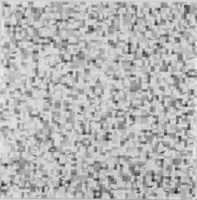
À la recherche de Paul Klee
(Searching for Paul Klee) 1970
This work in particular is so impressive, as it looks like a noise algorithm from far away, but on closer inspection it is filled with human detail.
I think a through line with many of these early works is intense iteration from limited systems. They were able to explore nearly every permutation of their associated system due to the limitations.
A quote from Frieder Nake showcases a similar idealogy of merging with the rules of the computer. "But I knew the code for the drawing machine so well that I could just change the paper tape as if I were the computer myself" (https://dam.org/museum/nake-interview/). Furthermore, this shows the limitations of the time actual enabled further specialization than what is required today. These early works all show artists who became extremely intimate with a specific practice or material.
À la recherche de Paul Klee
(Searching for Paul Klee) 1970
This work in particular is so impressive, as it looks like a noise algorithm from far away, but on closer inspection it is filled with human detail.
I think a through line with many of these early works is intense iteration from limited systems. They were able to explore nearly every permutation of their associated system due to the limitations.
A quote from Frieder Nake showcases a similar idealogy of merging with the rules of the computer. "But I knew the code for the drawing machine so well that I could just change the paper tape as if I were the computer myself" (https://dam.org/museum/nake-interview/). Furthermore, this shows the limitations of the time actual enabled further specialization than what is required today. These early works all show artists who became extremely intimate with a specific practice or material.