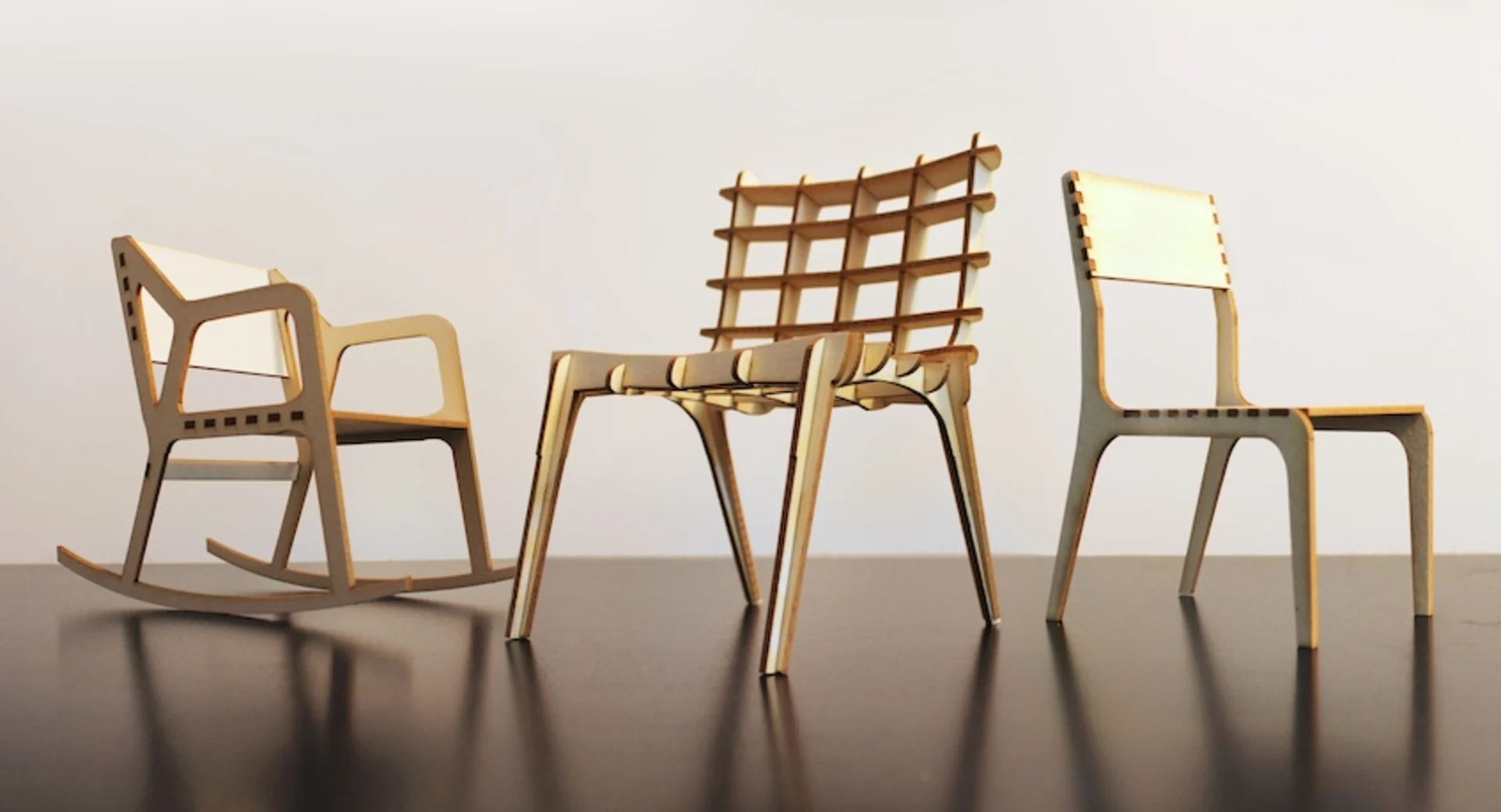
Sketch Chair, created by FRONT, redefines the relationship between drawing and making by translating abstract freehand sketches into three-dimensional physical products using motion capture technology. In such an approach, designers do not view drawings as two-dimensional images; instead, the process of drawing itself becomes the very foundation of the end product. Thus, the final chair still preserves the fluidity and improvisational nature of the process of drawing.
In Alan Rath’s 6 O’Clock, the figuration is given a distinctly different interpretation. His sculpture consists of several LCD screens placed in tandem on a forked aluminum structure, on which each screen displays a pair of disconnected hands moving in algorithmic gestures. Rath’s electronic system is dedicated to coding the paths of movement, which are constantly non-looping, adding an aura of autonomy to the installation. “The hands are at once familiar and alien, conjuring images of contemporary life in the digital age, in which the Self is commonly mediated into fragmentary actions delivered by devices—ticks, touches, clicks.” In this installation, it is the actions that lead to the emergence of individuality and create a hybrid life-form that exists between humanity and machine.
Stephanie Dinkins' project 'Conversations with Bina48' brings about an emotional and socio-political turn in the realm of artificial intelligence discussions. Through extensive conversations between the artist and the human-like artificial intelligence created in the mold of an actual black woman, the artist has showcased in this project that racial, cultural, and socio-historical biases get integrated into artificial intelligence systems. In this case, the artist has highlighted through conversations dotted with glitches, misunderstandings, and fleeting points of understanding that human limitation exists in artificial intelligence while emphasizing that it is human nature to strive for empathy and understanding in non-human systems. Indeed, the meaning of this project resides in its relational aspect, which keeps drifting towards human-machine relations.
wk7 11.04/11.06: Digital Object | Digital Fabrication, Robotics | Automation
-
jcrescenzo
- Posts: 9
- Joined: Wed Oct 01, 2025 2:17 pm
Re: wk7 11.04/11.06: Digital Object | Digital Fabrication, Robotics | Automation
Mert Toka
https://www.merttoka.com/page.html?slug=dynamovis
Passive Multi-touch Surface
https://www.merttoka.com/page.html?slug ... ch-surface Mert Toka’s (UCSB MAT Alumn) work of data visualizations is very interesting to me. Making touch as the medium of selection, filtering and so forth is not only novel but is crucial to building engagement with data. Though touch alone does not necessarily personalize data to people. It is an important mode of interaction, facilitating this exploration of data.
Light painting as a means to reveal aspects of geography is a brilliant idea. It is sort of an inversion of how we normally approach data visualization, where data is visible from the start to convey narrative information.
Another major design choice is the polygon selection, where users can outline an area, allowing them to group an area of selection for their choosing. This is another important feature to allow users to drill down to local information, find areas of interest and contrast to larger data trends.
Much of this work was a collaborative effort between many students across disciplines under the MOVE Lab, based in geography.
https://move.geog.ucsb.edu/opportunities/
DynamoVis
DynamoVis is a data visualization software specifically targeted for spatiotemporal movement data. The goal was to create a basic or simple interface that scientists could easily use to visualize spatial movement data. The timeline takes a lot of design from video editing software using a timeline for scientists to adjust their length of animated movement according to the time they set.
Somayeh Dodge, Mert Toka & Crystal Bae. DynamoVis 1.0: an exploratory data visualization software for mapping movement in relation to internal and external factors. Mov Ecol 9, 55 (2021).
https://www.merttoka.com/page.html?slug=dynamovis
Passive Multi-touch Surface
https://www.merttoka.com/page.html?slug ... ch-surface Mert Toka’s (UCSB MAT Alumn) work of data visualizations is very interesting to me. Making touch as the medium of selection, filtering and so forth is not only novel but is crucial to building engagement with data. Though touch alone does not necessarily personalize data to people. It is an important mode of interaction, facilitating this exploration of data.
Light painting as a means to reveal aspects of geography is a brilliant idea. It is sort of an inversion of how we normally approach data visualization, where data is visible from the start to convey narrative information.
Another major design choice is the polygon selection, where users can outline an area, allowing them to group an area of selection for their choosing. This is another important feature to allow users to drill down to local information, find areas of interest and contrast to larger data trends.
Much of this work was a collaborative effort between many students across disciplines under the MOVE Lab, based in geography.
https://move.geog.ucsb.edu/opportunities/
DynamoVis
DynamoVis is a data visualization software specifically targeted for spatiotemporal movement data. The goal was to create a basic or simple interface that scientists could easily use to visualize spatial movement data. The timeline takes a lot of design from video editing software using a timeline for scientists to adjust their length of animated movement according to the time they set.
Somayeh Dodge, Mert Toka & Crystal Bae. DynamoVis 1.0: an exploratory data visualization software for mapping movement in relation to internal and external factors. Mov Ecol 9, 55 (2021).
Re: wk7 11.04/11.06: Digital Object | Digital Fabrication, Robotics | Automation
I’m deeply interested in combining art and industry in my career. The example that struck me comes from Raffaello D'Andrea — we saw how what begins as robotic art can end up integrated into large-scale industrial systems. Early in his career he co-founded Kiva Systems, which rethought warehouse logistics. Later, that system was acquired by Amazon Robotics and now powers fulfillment centers around the world. Meanwhile, D’Andrea hasn’t abandoned his creative roots — he also creates robotic artworks like The Robotic Chair, a seemingly simple wooden chair that collapses and then autonomously reassembles itself, functioning as a kinetic art piece and a metaphor for self-renewal.

Another major influence for me is Neri Oxman — her work blends design, art, science, and engineering. She coined the term “material ecology” to describe her approach, aiming to create objects and structures that grow or assemble with nature rather than deplete it. I love how she envisions technology not as something opposed to nature, but as a means to harmonize with it — working in alignment with ecological principles and pushing the boundaries of design and construction.

For me, these two paths — the robotics-industry fusion of Raffaello D'Andrea and the biology-inspired design of Neri Oxman — shape how I imagine my future work: creating projects where art, technology, design and real-world utility come together in fresh, meaningful ways.

Another major influence for me is Neri Oxman — her work blends design, art, science, and engineering. She coined the term “material ecology” to describe her approach, aiming to create objects and structures that grow or assemble with nature rather than deplete it. I love how she envisions technology not as something opposed to nature, but as a means to harmonize with it — working in alignment with ecological principles and pushing the boundaries of design and construction.

For me, these two paths — the robotics-industry fusion of Raffaello D'Andrea and the biology-inspired design of Neri Oxman — shape how I imagine my future work: creating projects where art, technology, design and real-world utility come together in fresh, meaningful ways.
-
lucianparisi
- Posts: 9
- Joined: Thu Sep 26, 2024 2:16 pm
Re: wk7 11.04/11.06: Digital Object | Digital Fabrication, Robotics | Automation
What stood out to me this week was how “digital object” didn’t just mean a rendered model on a screen, but a whole pipeline where software, bodies and machines are tightly entangled. I kept coming back to three projects in particular: the Kinematic Dress, SketchChair, and the aluminum work of Neal Feay / Alex Rasmussen.
The Kinematic Dress (by Nervous System, often discussed alongside Neri Oxman’s work) feels like a clear example of digital fabrication at a wearable scale. A body scan becomes a parameter in a generative system; thousands of hinged pieces are computed, then 3D-printed as a single flexible textile. What I get from this is less “3D printing as novelty” and more the idea of garments as continuously reconfigurable, data-driven sculptures – clothing as an interface between computational design and lived movement.

SketchChair hits a different but related note: instead of couture, it focuses on making chair design accessible. A simple 2D drawing interface generates structural ribs and slot joints, which can then be CNC-cut and assembled. I like how the software doesn’t just simulate form; it quietly encodes ergonomics, structure, and fabrication constraints, so non-designers can still produce something that holds weight and fits a body. It frames digital fabrication less as “industrial magic” and more as a shared design tool.

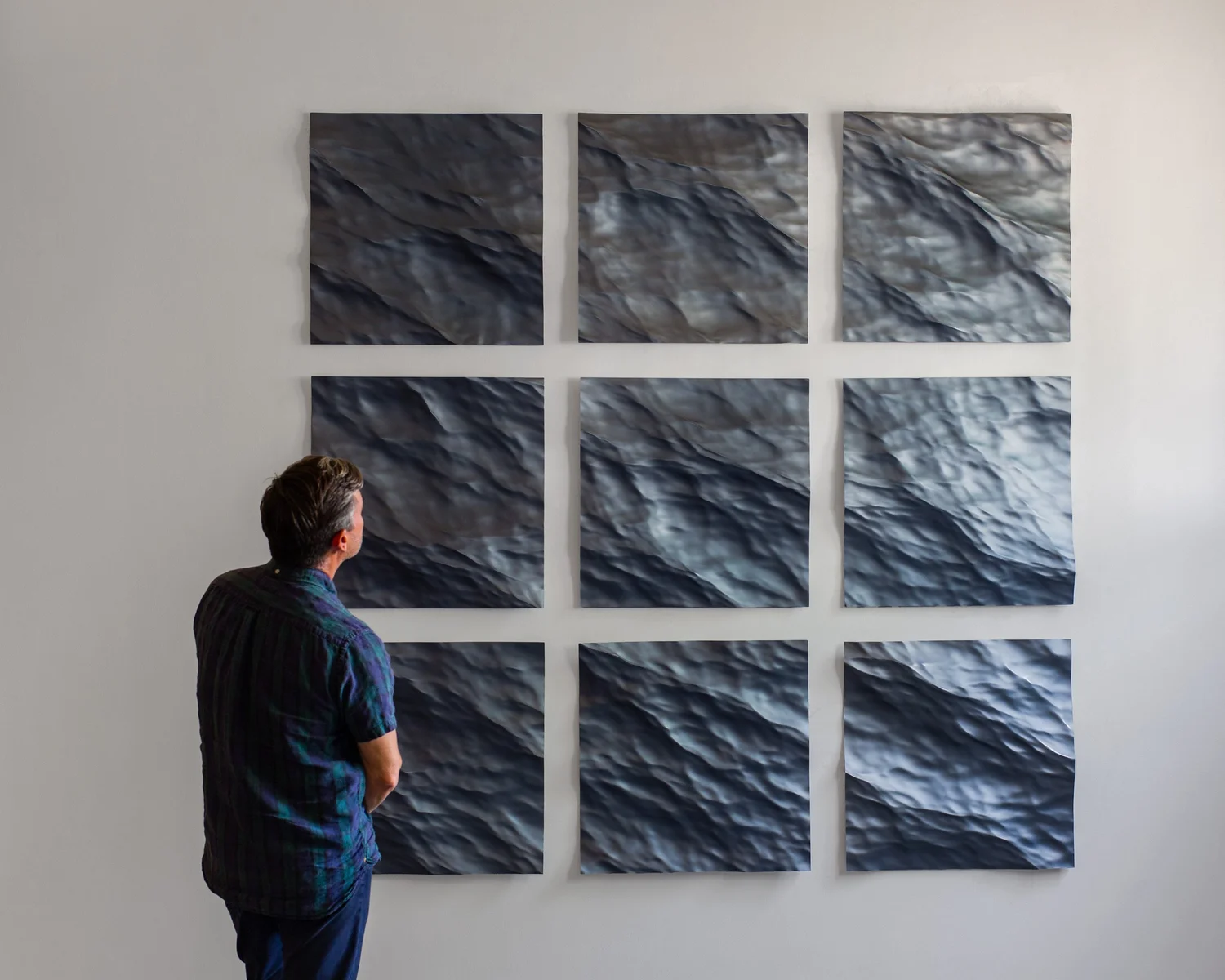
Neal Feay’s anodized aluminum pieces brought this same idea down to the level of surface. Rasmussen combines CNC machining with carefully controlled anodization to produce shifting optical effects—iridescent color, fine relief patterns—that feel part industrial component, part architecture, part sculpture. For me, this reinforced that computational craft isn’t only about 3D-printing new forms; it’s also about returning to familiar materials and pushing them in new directions through precise, code-driven processes that literally shape how light plays across a surface. Very compelling work

The Kinematic Dress (by Nervous System, often discussed alongside Neri Oxman’s work) feels like a clear example of digital fabrication at a wearable scale. A body scan becomes a parameter in a generative system; thousands of hinged pieces are computed, then 3D-printed as a single flexible textile. What I get from this is less “3D printing as novelty” and more the idea of garments as continuously reconfigurable, data-driven sculptures – clothing as an interface between computational design and lived movement.

SketchChair hits a different but related note: instead of couture, it focuses on making chair design accessible. A simple 2D drawing interface generates structural ribs and slot joints, which can then be CNC-cut and assembled. I like how the software doesn’t just simulate form; it quietly encodes ergonomics, structure, and fabrication constraints, so non-designers can still produce something that holds weight and fits a body. It frames digital fabrication less as “industrial magic” and more as a shared design tool.

Neal Feay’s anodized aluminum pieces brought this same idea down to the level of surface. Rasmussen combines CNC machining with carefully controlled anodization to produce shifting optical effects—iridescent color, fine relief patterns—that feel part industrial component, part architecture, part sculpture. For me, this reinforced that computational craft isn’t only about 3D-printing new forms; it’s also about returning to familiar materials and pushing them in new directions through precise, code-driven processes that literally shape how light plays across a surface. Very compelling work
-
felix_yuan
- Posts: 9
- Joined: Wed Oct 01, 2025 2:40 pm
Re: wk7 11.04/11.06: Digital Object | Digital Fabrication, Robotics | Automation
Robots, as both a very popular theme in various sci-fi novels and movies and a rapid developing technology, is the closest and most familiar form of artificial creature for people. Artists have used these concepts to make amazing work with robots, whether seeing robots as a autonomous mechanical life form or as an extension of human body. And as humankind has now concurred most, if not all, actual life-threatening factors from nature environment, thus in a certain way paused the nature-selection, the process behind species’ evolvement, extending human body with robotic devices or creating new robotic creature can be a possible and interesting way for humankind to continue the evolution.
Stelarc
Stelarc uses robotics in a very creative, or even a creepy way as his style artistic expression. He explored the new possibility of how humans or an alien like human could be like by using robotic as an extent of human body.
An early work Third Hand is a more intuitively way of using robots as the extension of the body. By a simple idea of adding one more joint to one side of the arm and the performance, the work visualized and explored the evolution of our relation to technology. As technologies like internet become part of our daily necessities, even invisibly, we are already becoming human with a third hand. In Exoskelton, Stelarc combined a spider-like walking method and audaciously created this mechanical chimera of people and a 6-legged creature with walking, turning, squatting and lifting behaviors. This work ended up with surprisingly shocking even with simple idea and showed how robots owns a aesthetic of its own. In the later work Shadow suspension, the chimera is now a group of 6 people together with hanging mechanics. This work not only inherited the theme of suspension of Stelarc’s work but also reflects how combining human and mechanics can show the object side of the most lively and familiar creature. The way 6 people as a group turning into a still sculptural like object is deeply thrilling. Alan Rath
Alan Rath’s, in another approach, explored robots with human characteristics, in other words using human as the extension of robots.
His sculpture series combined robotic structure with human organs, and is a fun experiment with people’s perception for both human and robots. It is interesting to think about when human facial organs are appearing on a robot, do we recognize this as more human or more robotic. He also created interesting mechanical arms that has certain human-like behavior.
Stelarc
Stelarc uses robotics in a very creative, or even a creepy way as his style artistic expression. He explored the new possibility of how humans or an alien like human could be like by using robotic as an extent of human body.
An early work Third Hand is a more intuitively way of using robots as the extension of the body. By a simple idea of adding one more joint to one side of the arm and the performance, the work visualized and explored the evolution of our relation to technology. As technologies like internet become part of our daily necessities, even invisibly, we are already becoming human with a third hand. In Exoskelton, Stelarc combined a spider-like walking method and audaciously created this mechanical chimera of people and a 6-legged creature with walking, turning, squatting and lifting behaviors. This work ended up with surprisingly shocking even with simple idea and showed how robots owns a aesthetic of its own. In the later work Shadow suspension, the chimera is now a group of 6 people together with hanging mechanics. This work not only inherited the theme of suspension of Stelarc’s work but also reflects how combining human and mechanics can show the object side of the most lively and familiar creature. The way 6 people as a group turning into a still sculptural like object is deeply thrilling. Alan Rath
Alan Rath’s, in another approach, explored robots with human characteristics, in other words using human as the extension of robots.
His sculpture series combined robotic structure with human organs, and is a fun experiment with people’s perception for both human and robots. It is interesting to think about when human facial organs are appearing on a robot, do we recognize this as more human or more robotic. He also created interesting mechanical arms that has certain human-like behavior.