Generative Art is defined as a piece of art created by a system that operates autonomously from the artist. The systems can be rule-based, algorithmic, mechanical, social, or purely chance-driven, but all operate in a way not predetermined by the artist. Of course, that broad definition could lead to some philosophical discussion of what autonomy actually is, but that probably is a discussion for another day. Coming from the musical world, this is a common topic; music has many mathematical and logical frameworks, so I am surprised it is not discussed more on the visual side of the art spectrum. "Generative Art Theory," the assigned reading written by Philip Galanter, mentions the use of generative systems in electronic music. Still, generative music has a deeper history than that. For example, my mind automatically thinks of Musikalisches Würfelspiel (musical dice game), an 18th-century stochastic method for writing waltzes and other musical compositions. As a result, many unique compositional pieces could be created from a relatively compact source, making them valuable for dinner parties. It is claimed that Mozart wrote such a piece, but the evidence is a bit suspect. What fascinates me most is Philip Galanter’s complexity framework, which classifies systems according to their level of chaos.
Low complexity = pure order (e.g., perfect symmetry)

Sol LeWitt's Wall Drawing #118 is an excellent example of low-complexity generative art. Its creation follows a small, clearly defined set of rules. The instruction is straightforward: “On a wall surface, any continuous stretch of wall, using a hard pencil, place fifty points at random. Straight lines should connect the points.” Although the placement of points is technically “random,” the result is made up of perfectly straight connections that consistently form the same geometric web. There is no evolution, emergence, or feedback within the system; it relies solely on a fixed set of instructions that creates a similar structure every time. The artwork is generative because the instructions lead to the drawing. However, its predictability and rigidity, along with a lack of internal variation, position it firmly on the low-complexity end of the generative spectrum.
Mid-complexity = the “edge of chaos,” where structure and variation coexist
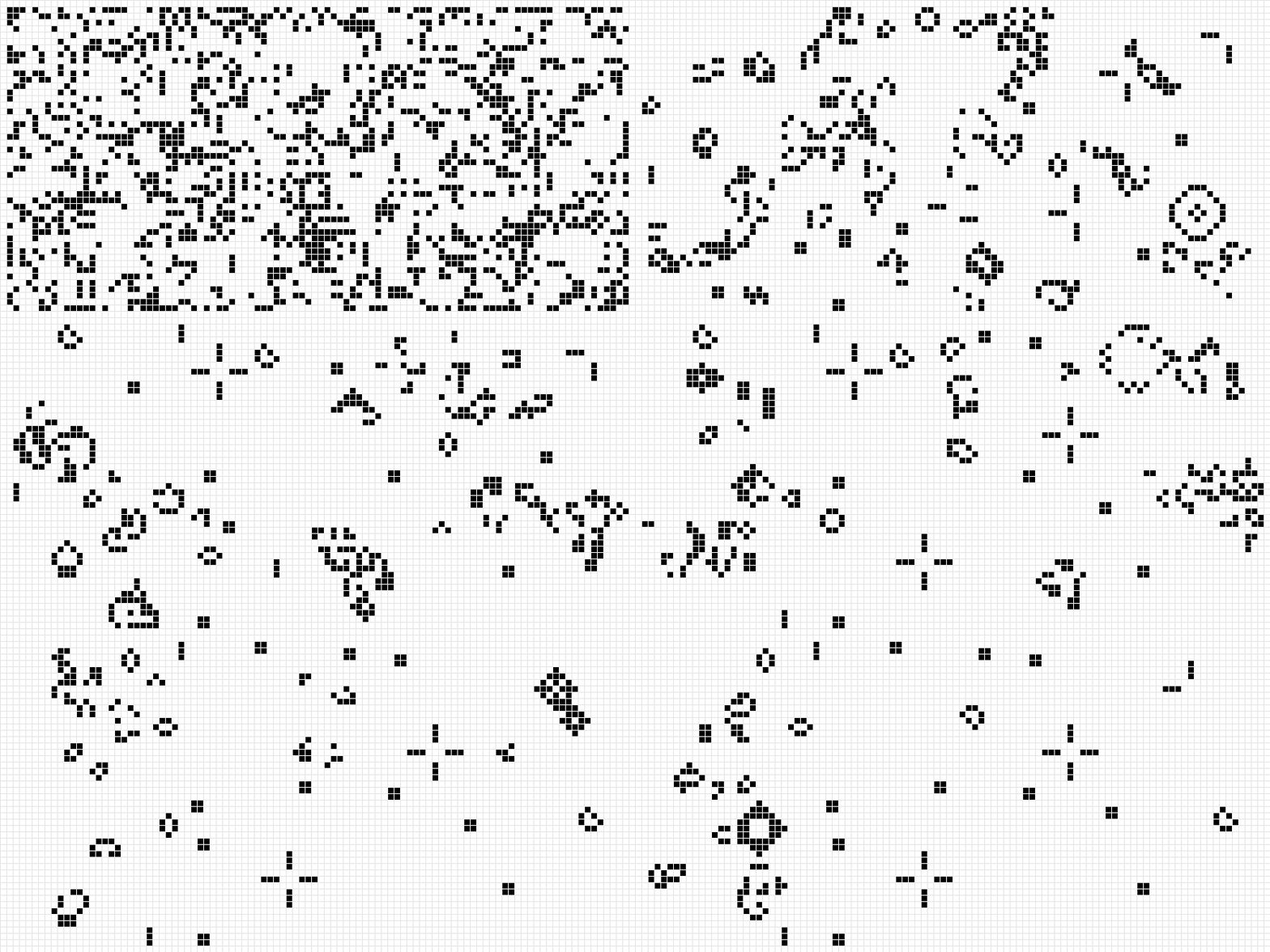
Conway’s Game of Life is one of the best-known examples of mid-complexity generative art. It sits at the “edge of chaos,” where structure and unpredictability coexist. Life follows a simple set of rules. Cells live, die, or are born based on their neighboring cells. From this minimal logic, it creates endlessly surprising patterns, such as gliders, oscillators, and complex moving structures. The artist does not design these forms; they emerge from the interactions within the system. This makes the artwork generative rather than prescriptive. The Game of Life is neither completely ordered nor entirely random. Patterns can stabilize, replicate, or explode unpredictably, but they always follow the underlying rules. This balance of constraints and freedom makes Life a key example of mid-complexity generative systems, where emergent behavior, self-organization, and structured unpredictability thrive together.
high complexity = pure randomness (noise)
 https://youtu.be/AVoV9xV_LU4?si=ZGxdHfOWorBpG3qF
Karl Sims's particle-system artworks showcase high-complexity generative art. In these pieces, Sims creates large swarms of digital “particles” (tiny points or agents) that move according to simple physics rules such as attraction, repulsion, turbulence, and random forces. Each particle acts independently and responds to changing environmental factors. As a result, the system quickly becomes unpredictable and chaotic. Unlike generative works that maintain stable structures or repeating forms, Sims’ particle fields seldom settle. They drift, collide, scatter, and transform into constantly evolving clouds of motion. The artist sets the rules, but the system creates complex, swirling dynamics that no one could fully predict or control. This places Sims’ particle systems at the chaotic end of the complexity spectrum. There, variation is very high, order is minimal, and the artwork resembles a digital version of fluid turbulence or storm patterns. These works are well-known for showing how simple code can lead to rich, overwhelming complexity.